
Is Trump About to Surrender?
Or is this another ruse to obscure pending hostility...
Happy Sunday, folks. It is a holiday weekend here in the US, yet things on the geopolitical stage are moving at breakneck speed. Media outlets are reporting a potential ‘memorandum of understanding’ for the Iran war is on the cusp of being signed. But I am seeing some mixed signals. Is this alleged agreement another ruse? If it’s real, what provisions does it include? What happens if it fails?
If you find this newsletter informative and care to offer a little something in support, feel free to buy me a coffee or subscribe. For those of you who prefer storytelling and art over this fictionalized reality we are living through, check out my other site, Inverted Umbrella.
Now, to the business at hand…
Photo by Pedro Farto on Unsplash
I woke (very) early this morning to a barrage of headlines claiming a ‘memorandum of understanding’ needed only a ‘fine-tuning’ before the various parties would sign it. This MoU (or letter of intent, or whatever they’re calling it at the moment) would put a hard end to the Middle East war, at least for a month or two, to enable further negotiations. Immediately, I had simultaneously contradictive thoughts—this is a great development and… is Trump about to attack?
Let’s first examine the reporting on the purported agreement to try and discern what it actually includes, then we will consider the implications if this is just another Trump feint to hide a plan to resume attacks. This piece is being written and posted far faster than I prefer, so please forgive any errors.
The MoU
Unsurprisingly, various media outlets from around the world are giving different renditions of what provisions this purported MoU contains. For example, both the Jerusalem Post and Iran’s Fars News reported the US and Iran would open the Strait of Hormuz, but it would remain under Iran’s control (presumably with its toll system in place). Yet, the Jerusalem Post also noted Axios claims the strait must be opened without the toll system.1 So, it’s not clear which is the case—it’ll be under Iranian control or it won’t.
The nuclear issue is also unclear. The Hindustan Times reported Iran's foreign ministry spokesperson Esmail Baghaei said nuclear matters were not part of these discussions. But Breitbart wrote US Secretary of State Marco Rubio continues to insist “Iran can never have a nuclear weapon and must turn over its highly enriched uranium.” The Jerusalem Post claims nuclear issues “would still be largely under negotiation, although the MoU would call for Iran to cease any pursuit of nuclear weapons.” So it’s not clear to what extent, if any, the MoU deals with that matter.
It seems as if this document is primarily intended to get something on paper that says the parties will all agree not to shoot at each other for another month or two, including in Lebanon, and maybe open the strait in some fashion or another to avoid completely tanking the global economy. Whatever the agreement ends up looking like, it smacks of a Trump surrender—the ‘regime’ hasn’t changed, it still has its weapons and uranium, and Iran does not appear ready to abandon its allies.
My suspicion is that this agreement is Trump’s much-needed offramp. I think he wants to accept whatever Iran’s conditions are and then lie about them to the American people (infamous neocon Robert Kagan made precisely this argument). Subservient corporate media will simply print his statements as if they’re newsworthy (and true), thereby reinforcing what he will try to frame as a ‘victory’. Before the public can pontificate on the matter, Trump will ignite a fresh news cycle, perhaps by attacking Cuba.
There is one caveat.
The pro-Israel lobby and war-hawk politicians in the US are also characterizing this as a surrender. The concern among Middle East watchers now is they may work to sabotage the agreement. Trita Parsi, an expert on the geopolitics of the Middle East, wrote:
Sanctions relief would liberate Iran’s economy from decades of constriction and gradually shift the regional balance of power away from Israel and its vision of a “Greater Israel.” For precisely that reason, Israel will almost certainly do everything within its power — behind the scenes — to sabotage the agreement before it becomes irreversible.
Such saboteurs certainly have a lot of levers they can pull to manipulate Trump into breaking the deal. Moreover, Trump’s own indiscipline (to put it mildly) could unravel the entire diplomatic process. Indeed, on Saturday he exhibited this when he told Axios there was a “solid 50/50” chance between making a “good” deal or “blow[ing] them (Iran) to kingdom come.” Yet, also on Saturday, he posted on his social media, “An Agreement has been largely negotiated, subject to finalization between the United States of America, the Islamic Republic of Iran, and the various other Countries.”
The Iranian spokesman told Al Jazeera what they proposed in the MoU was the limit to the concessions they would make. He also claimed that while he was confident in the progress made so far, Washington’s “contradictory signals” threatened to derail the process. Iranian state media, for example, said Trump’s claim the deal is “largely negotiated” is “incomplete and inconsistent with reality.”
Surely you’ll understand if I am skeptical this will result in anything productive. Trump is probably hearing arguments in both directions from his allies. Many Republicans are likely saying he needs to end this to prevent a massacre at the midterms. Others—like Lindsey Graham and Mark Levin—are probably begging him not to ‘abandon’ Israel. The direction Trump will choose to go will depend on who can flatter him the most.
And there remains the possibility Trump is not serious about this agreement at all. Like he has done in the past, he could be using this process as a distraction while he prepares a new attack. I don’t think Iran would fall for it, but that fact is not likely to deter Trump if this is his intent.
So, what if talks fall apart?
A Pyrrhic ‘hot’ war
Outside of Asculum, a Roman city near the Adriatic Sea, the Greek King Pyrrhus looked out at a battlefield stilled by the nightfall. Reflecting upon the carnage before him and the previous battles he fought against the Romans, the king is claimed to have said ‘while my victories gave me joy, one more such victory is sure to undo me.’2 This was later enshrined into an expression: the Pyrrhic victory.
A Pyrrhic victory is one in which the cost to the winner is so great that it essentially constitutes a defeat. This is precisely what the Americans face in the standoff against Iran, in the event they proceed with resuming the war and they actually win.
If the MoU negotiation fails or the US or Israel simply decide to abandon any attempt at diplomacy and instead resume strikes, the outcome does not look good by any measure. A hot war could include airstrikes, a ground invasion, a naval assault, or any combination thereof. (And it would be a literal hot war, as the summer is approaching. I’ve been in Doha, Dubai, and Riyadh at various times of the summer—to call the heat stifling is a dramatic understatement).
Iranian officials have offered a glimpse of what they plan to do should war resume. Army spokesperson Mohammad Akraminia, for example, warned:
If the enemy is foolish enough to fall into the Zionist trap again and launches new aggression against our beloved Iran, we will open new fronts against it, with new equipment and new methods.
The Hormuz Letter posted on X what those ‘new fronts’ might be:
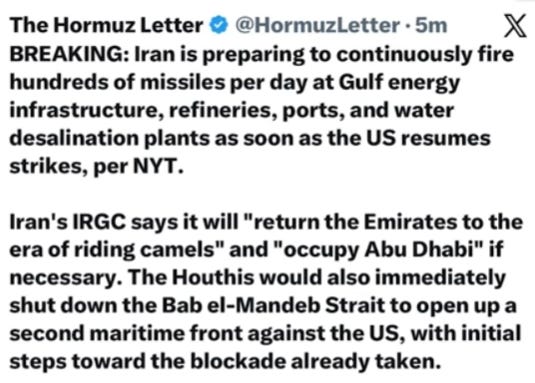
BREAKING: Iran is preparing to continuously fire hundreds of missiles per day at Gulf energy infrastructure, refineries, ports, and water desalination plants as soon as the US resumes strikes, per NYT.
Iran’s IRGC says it will “return the Emirates to the era of riding camels” and “occupy Abu Dhabi” if necessary. The Houthis would also immediately shut down the Bab el-Mandeb Strait to open up a second maritime front against the US, with initial steps toward the blockade already taken.
I have little doubt Iran will do this if attacked. Iran and the UAE were at odds long before this war, and both have launched attacks against each other in this one. Iranian officials have repeatedly stated attacks on their infrastructure validate similar attacks by them against others.
I have little doubt Iran can do this, at least for long enough to create an unprecedented catastrophe. We know, for example, the Houthis can effectively close the strait connecting the Red Sea to the Gulf of Aden—they have done it before. They don’t need to form their own blockade, they just need to sufficiently frighten ship owners and their insurers. The move would create an even graver economic problem for the world.
We know from American intelligence’s own reporting Iran’s missile capability remains intact. What we don’t know (though intelligence agencies might) is the level of sophistication of the missiles the Iranians haven’t yet used. Iranian officials have repeatedly teased they’ve kept the best stuff for last.
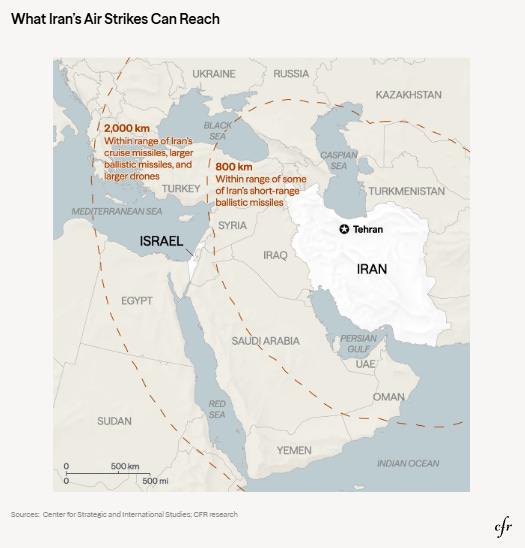
Weapons experts agree Iran possesses ballistic missiles with a range of 1,240 miles. These missiles can reach as far as Kosovo if launched from Iran’s northern provinces—they can easily hit Israel and the Gulf states. Ballistic missiles are much harder to intercept than other missile types or drones. Malcolm Davis, a senior analyst at the Australian Strategic Policy Institute, told Reuters:
If the Iranians launch another much larger attack, it is likely that more missiles will get through, particularly if ballistic missile attacks are coordinated with cruise missile and drone attacks.
Davis made that comment almost two years ago. The Iranians have had a lot of time since to produce as many missiles as they can, perhaps including new models with capabilities unknown by their adversaries, and they have acquired real-time experience on how best to use them. Furthermore, Israel and other US allies have watched their interceptor inventories diminish to nearly nothing. In short, Iran possesses considerable ability to inflict harm.
What may be more frightening than Iran’s capability are the targets to which it would direct that capability. Seyed Mohammad Marandi—a figure who has often been called the “mouthpiece” of the Iranian government—has repeatedly warned the Iranians will attack specific infrastructure in Israel and Arab states if its own is struck. This includes power grids and desalination plants; the destruction of either would put Gulf states’ very survival in serious peril.
As Marandi has pointed out, without electricity (and the air conditioning it generates) the region becomes unlivable to most people in the summer. On May 21, for instance, the high temperature in Riyadh reached 109° F (42.7° C). Like I said, I’ve experienced summer there—Marandi is definitely correct about the region’s unlivability, at least for those who have not been acclimated to the extreme heat, and this includes some native Arabs. Several generations of them have been raised in glamorous, well-air-conditioned cities like Dubai or Doha, thereby reducing their tolerance to the extreme heat. In Saudi Arabia, 82% of the population lives in cities; in the UAE its 86%; and in Kuwait and Qatar it is nearly 100%.
In my experience, during the most brutal part of the day (from roughly a couple hours after sunrise to late into the evening or even midnight), the only people you typically see outdoors are the poor, foreign workers (also usually poor), and essential employees (like first responders, airport workers, etc.). The absence of electricity appears to me to be a very serious problem, at least among the urban populations.
Destruction of desalination plants is an even greater threat. Ginger Matchett at the Atlantic Council notes roughly 5,000 desalination plants provide drinkable water to 100 million people in the region. Iran wouldn’t need to destroy them all to trigger a crisis—just 65 of them produce over 90% of the water. Matchett also provided the breakdown of how much of each country’s fresh water is produced by these plants:
UAE - 42% of the countries’ supply;
Saudi Arabia - about 70%;
Israel - 80%;
Oman - roughly 86%;
Kuwait and Bahrain - around 90%;
Qatar - nearly 99%.
Iran, conversely, relies very little on desalination. It depends instead on dam reservoirs, wells, and an ancient water collection system called qanats. But it has its own water problems. The Iranians have sought to become food-independent. In so doing, they have over-pumped the country’s underground natural water reservoirs that supply the manmade infrastructure. Mismanagement of water allocation and climate change have worsened the situation. Adding to all that, the country is in its sixth year of severe drought. The water crisis has been a major driver behind some of the larger protests over the last few years.
Curiously, Iran’s water shortage may serve as a motivation in the war. Hydrologists in the country have advised that once Iranian farmers can export foods, they can switch to less water-hungry cash crops. This would slow the current water crisis and provide more time to restore the qanat system (which has operated successfully for more than 2,500 years). To be able to export sufficient volumes of crops to make the switch worthwhile, Iran needs the sanctions to be lifted—something that will happen if it wins the war.
Iran’s water problem is significant, but slow rolling. The war could change that. American or Israeli forces could target reservoirs and other water infrastructure, creating a much more swiftly developing crisis. At what point this could reach sufficient severity to affect the war remains an open question.
For the Gulf states, however, the timeline is clear. If Iran destroys their desalination plants, there will be an immediate and profoundly dangerous situation for millions of people. Fleeing the region will be their only choice for survival. In 2008, officials at the US State Department warned if Saudi Arabia’s desalination plant at Jubail was destroyed or shut down through sabotage, Riyadh would have to evacuate “within a week.”3 Modern plants can also be shut down through cyberattacks. Some of Saudi Arabia’s most productive desalination plants sit on the Persian Gulf—in easy range of Iranian missiles. Others are targetable by the Houthis.
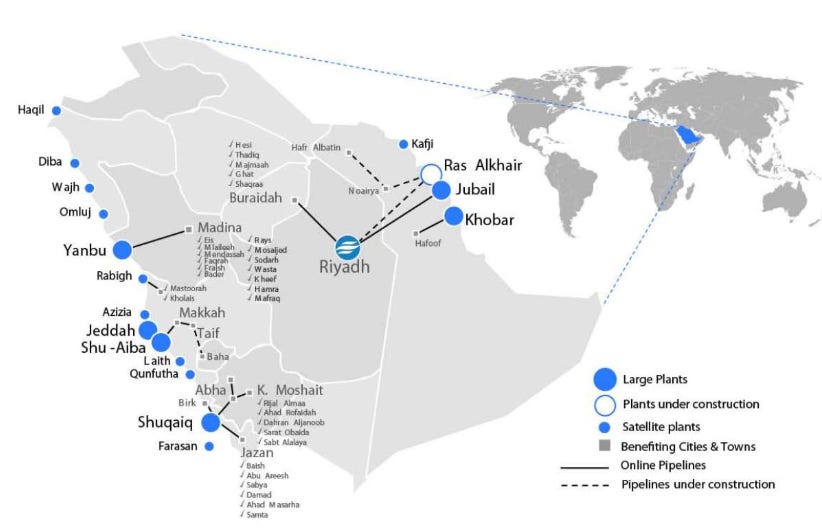
Credit: Abdul Latif Jameel
Should Iran choose to only partially damage or impede the function of such facilities, it could still cause a troubling ripple effect. The Gulf states’ electricity networks rely on the water pumped in by desalination plants for cooling, so obstruction could lead to widespread blackouts, circling around to the problem of the region’s intense heat.
Clearly, a resumption of hostilities risks the outcome of a great deal of carnage, and I have not even mentioned the global economic collapse that looms should the conflict continue for long. (I don’t need to go over it here; I’ve discussed it elsewhere). Even if the Iranians eventually surrender unconditionally or the government collapses—either event could fairly be called a victory for the US and Israel—it would be a Pyrrhic victory at best given the sum of destruction it would do to the region and the world.
Coda
In my first piece on this unfolding disaster in the Middle East, I explained in detail why a full ground war conducted by the United States is not likely to happen. You can see my full analysis in the piece linked at the end of this one. The key obstacles to a ground invasion are:
Neither the US nor Israel have the necessary number of troops;
While there is scant political will in the US for a ground invasion, the populace’s apathy will likely turn to powerful, maybe even violent, protest should Trump attempt to institute a draft, which would be necessary to build troop levels high enough.
American and Israeli troops would be facing multiple hostile forces at once: the Artesh (Iranian regulars), the IRGC, Iran’s reserves and proxies, and perhaps even Iranian citizens taking up arms in self-defense;4
The United States lacks the manufacturing capacity for a sustained ground war;
Iran’s geographic composition and massive size presents a formidable problem, as does the matter of where the Americans could amass troops safely; large collections of troops would immediately be targeted by Iran even if the war has not ‘officially’ resumed;
If said troops managed to safely amass, from where would they push into the Iranian interior? It’s not certain whether the Gulf states would allow them to use their lands out of risk of severe reprisal from Iran.
Despite my confidence the US will not conduct a ground war on the scale it would need to succeed at conquering Iran, I do not hold the same confidence that airstrikes or other efforts are finished. Much is riding on whether the MoU is signed and how successful the saboteurs might be in undermining it. What I fear most is if we return to a hot war, the targets American officials choose to strike will influence what the retaliation looks like, and the results from such retaliation could range from an elevated crisis to a full-blown catastrophe, one that will forever change the world.5
There is ample evidence to suggest that media outlet Axios, and particularly its reporter Barak Ravid, craft articles to manipulate the public in favor of Israel. Ravid is a “former analyst with Israeli spying agency Unit 8200, and as recently as last year, was still a reservist with the Israeli Defense Forces group.”
U.S. Department of State, Embassy Riyadh, “Critical Infrastructure Protection in Saudi: Next Steps,” Cable, August 11, 2008.
CNN reported (with pictures) on the “appearance of public gun kiosks” at pro-Iran rallies in Tehran. A 47-year-old housewife told Agence France-Presse, “We bring our children and teenagers alongside us so they can see military training, and whenever our leader, dearer than our lives, gives the command, we will all come to the field.”
It is hard to even begin to imagine how an evacuation of the Middle East would proceed if desalination plants are destroyed. Where would people go? Moreover, what would happen to the global economic system? The stakes here may be the greatest humanity has ever faced, and certainly the greatest of our lifetimes. And we have the likes of Donald Trump to manage the situation.
It’s no longer interesting what President Trump has to say about the war. We have to wait for the Iranian assessment on what he says.
The most likely explanation for ANYTHING Trump says is ‘He's lying’.
The second most likely explanation for anything he says is he's pivoting to a different lie.
The third most likely explanation is he's pivoting to a temporary acceptance that the lie he's been repeating isn't convincing most of even his regular base, and turning some of them against him, only to revisit the lie on a regular basis until he can revive it full time.
Because his lies about how his war against Iranians is going are falling into that ‘not convincing’ category, he's possibly ‘pivoting to another lie’, trying to get a ‘deal’ that, to low information Iranians will sound like most of what Iranians want, while sounding to low information Americans like extracting a ‘win’